
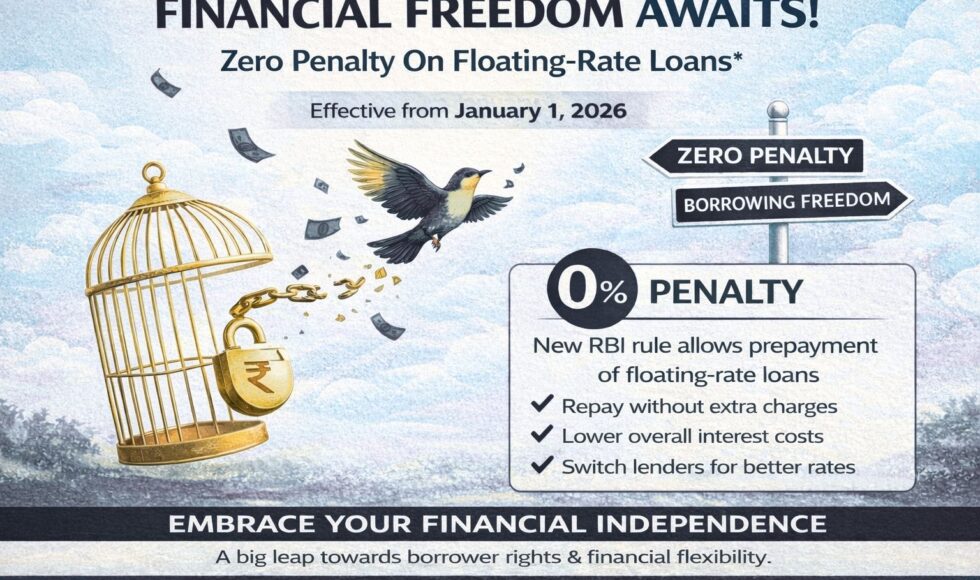
Effective from January 1, 2026
The Reserve Bank of India (RBI) has introduced a significant regulatory reform aimed at strengthening borrower rights and improving transparency in the lending ecosystem. Effective January 1, 2026, banks and Non-Banking Financial Companies (NBFCs) will no longer be permitted to levy prepayment or foreclosure charges on most floating-rate loans extended to individuals and Micro, Small and Medium Enterprises (MSMEs).
This move marks an important step toward making loan repayment more flexible, cost-efficient, and borrower-centric.
Understanding the New RBI Regulation
Under the revised guidelines, lenders are prohibited from charging any penalty when a borrower chooses to:
Make partial prepayments, or
Foreclose (fully repay) an eligible floating-rate loan before the end of its tenure
This applies regardless of whether the prepayment is made from the borrower’s own funds or through refinancing with another lender.
Scope and Applicability
The regulation applies to floating-rate loans availed by:
Individuals
MSMEs / Small businesses
Covered loan categories include:
Home Loans
Personal Loans
Vehicle Loans
Education Loans
Other floating-rate personal and business loans
The objective is to ensure borrowers are not financially penalized for responsible repayment behavior or for seeking better interest rates elsewhere.
Key Benefits for Borrowers
This regulatory change delivers multiple advantages:
Zero prepayment penalty – borrowers can repay loans early without additional costs
Lower total interest outflow over the loan tenure
Greater flexibility to manage surplus funds efficiently
Simpler loan switching to lenders offering better interest rates or terms
Enhanced transparency and fairness in loan agreements
Overall, borrowers gain stronger control over their financial planning and debt management strategies.
Illustrative Example
Consider the following scenario:
Total Loan Amount: ₹50 Lakhs
Outstanding Balance at Prepayment: ₹30 Lakhs
Earlier (Old Rule):
Prepayment charges (approx. 2%) = ₹60,000
Now (New Rule):
Prepayment charges = ₹0
✅ Direct saving of ₹60,000, along with reduced future interest costs.
Important Clarifications
The regulation applies to most banks and NBFCs operating in India.
Certain limited exceptions may exist for select co-operative banks, small banks, or specific loan categories (generally loans up to ₹50 lakh).
Borrowers are advised to review their loan agreements or consult their lender for exact applicability.
What This Means in Practice
If you have a floating-rate loan that is sanctioned on or after January 1, 2026, you can:
Repay partially or fully at any stage
Switch lenders without penalty
Reduce long-term borrowing costs
All without worrying about hidden prepayment or foreclosure charges.
Conclusion
The RBI’s decision reinforces its commitment to borrower protection, transparency, and financial empowerment. By eliminating prepayment penalties on floating-rate loans, this reform encourages healthy competition among lenders and enables borrowers to make smarter, more informed financial decisions.